Assistant Professor applicant

Hi, I'm
Sam EskandariNasab.

I am MohammadReza EskandariNasab, also known as Sam, a name inspired by the legendary Persian hero featured in the Shahnameh. I am a fourth-year PhD candidate in Computer Science at Utah State University, where I also earned my MSc in Computer Science. I currently serve as a Graduate Research Assistant and am actively seeking Assistant Professor positions.

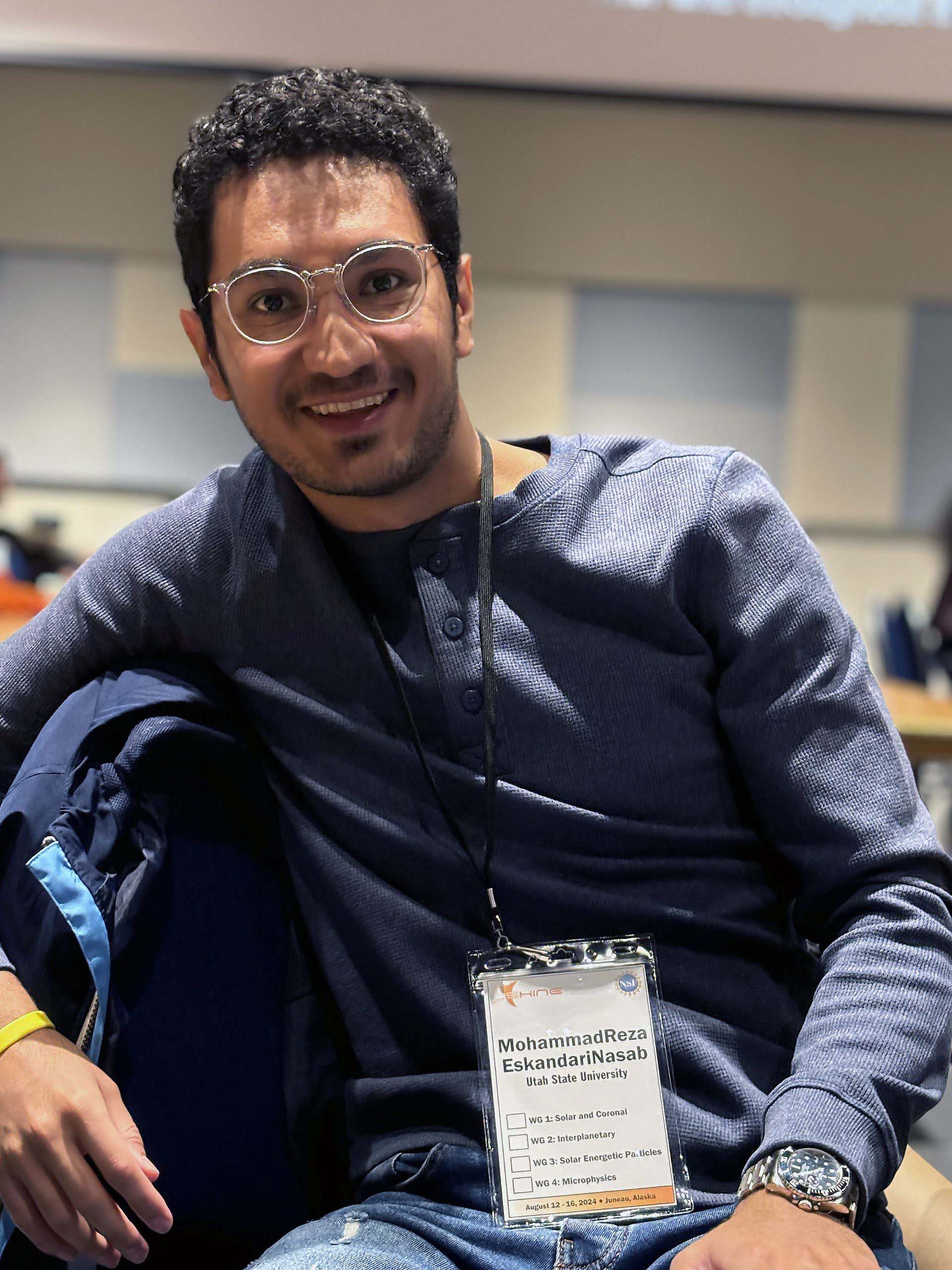
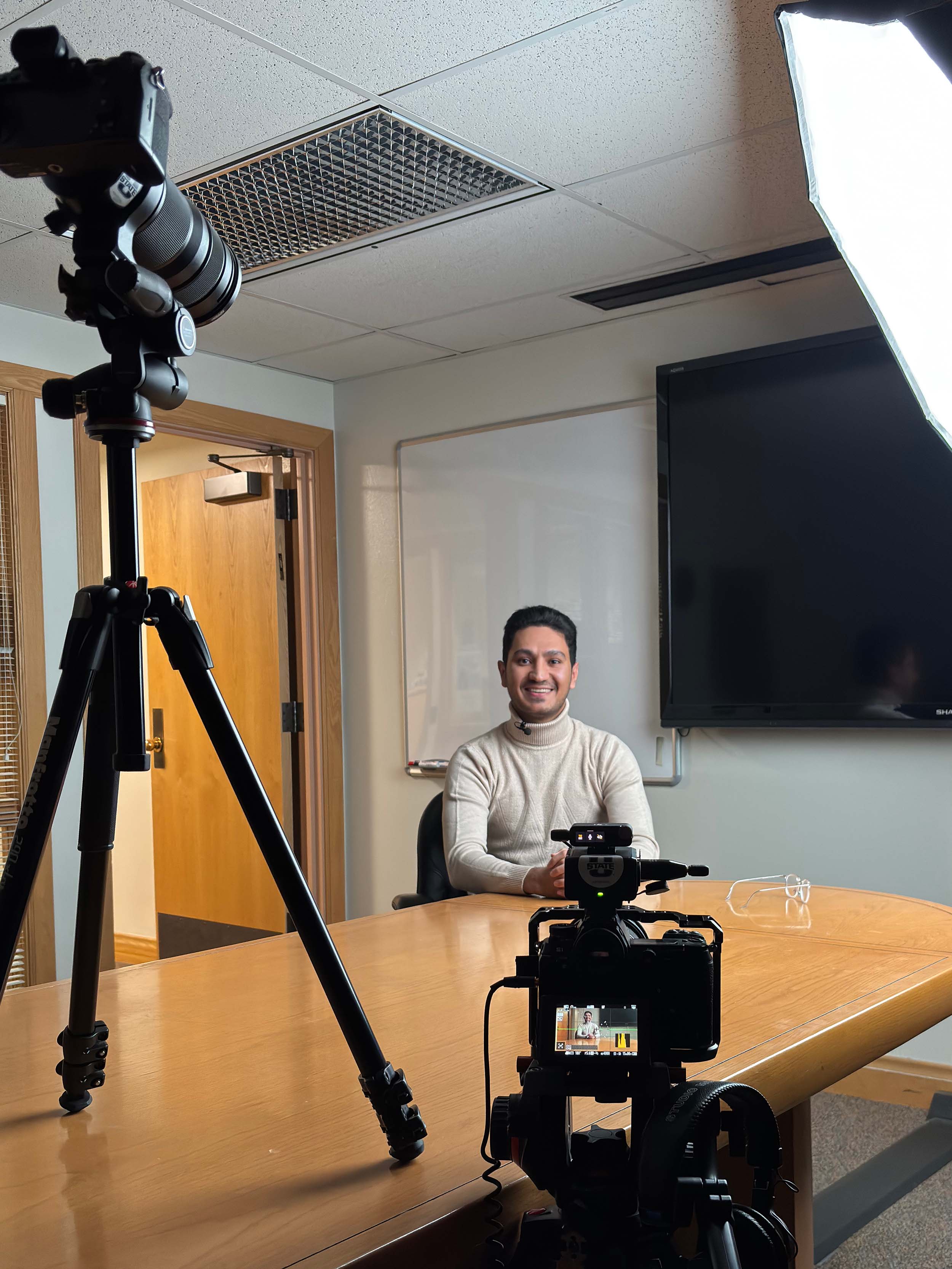
Portrait of MohammadReza (Sam) EskandariNasab

Academic profile

AI for scientific data generation & space-weather prediction

I am MohammadReza EskandariNasab (Sam), a PhD candidate in Computer Science at Utah State University in Logan, Utah. My research centers on generative modeling for time-series data, including diffusion models, generative adversarial networks, and adversarial autoencoders, with publications at IEEE ICDM, SIAM SDM, IEEE BigData, and IEEE ICMLA. My current work extends this research into multimodal learning through an NSF-funded project (Award No. 2530946), generating and translating across images, text, vector data, and time series through the proposed UNISON framework.

Alongside this, I build machine-learning pipelines that forecast solar flares, solar energetic particle events, and coronal mass ejections. This work has been published in The Astrophysical Journal Supplement Series and presented at IEEE ICDM 2025, with three additional manuscripts currently in submission. I have also led the development of FlaPLeT.org, an NSF-funded (Award No. 2305781) no-code platform for training and evaluating space-weather machine learning models, published in SoftwareX.

My work focuses on developing robust AI methods for scientific discovery, with particular emphasis on generative models, multimodal data fusion, and predictive modeling for complex spatiotemporal systems, as I pursue a tenure-track Assistant Professor position in computer science.

Experience

Research & professional experience

Graduate Research Assistant

Utah State University

  • Proposed UNISON, a multimodal diffusion-transformer framework for generative modeling across time series and other modalities, funded by NSF Award #2530946 (CAIG); manuscript targeting ICLR/ICML 2026.
  • Developing solar energetic particle (SEP) event prediction pipelines, with manuscripts in preparation for The Astrophysical Journal and ApJS.
  • Continuing research on multimodal generative learning for space-weather time-series data.

Graduate Research Assistant

Utah State University

  • Developed TIMED, AVATAR, SeriesGAN, and ChronoGAN — generative models built on DDPMs, GANs, and adversarial autoencoders for time-series generation, funded by NSF Awards #2305781 and #2530946.
  • First-author work published at IEEE ICDM 2025, SIAM SDM 2025, IEEE BigData 2024, and IEEE ICMLA 2024.
  • Designed preprocessing and contrastive representation-learning pipelines for solar flare prediction, published in The Astrophysical Journal Supplement Series.

Full Stack Developer

Utah State University

  • Built FlaPLeT, a full-stack NSF-funded (#2305781) platform for end-to-end solar-flare ML workflows, published in SoftwareX (2026).
  • Enabled account creation, dataset upload, preprocessing, augmentation, classification, and performance reporting.
  • Stack: Django, REST APIs, React, PostgreSQL, Celery, Redis, Nginx, Waitress, TensorFlow, Keras, Pandas.

Education

Academic background

PhD in Computer Science

Utah State University · GPA 4.0/4.0

Dissertation:
Proposal on denoising diffusion probabilistic models and multimodal learning.

Supervisor: Dr. Shah Muhammad Hamdi.

MSc in Computer Science

Utah State University · GPA 4.0/4.0

Thesis:
Supervised Generative Adversarial Networks for Time Series Generation in Embedding Space.

Supervisor: Dr. Shah Muhammad Hamdi.

BSc in Computer Engineering

University of Zanjan · GPA 3.88/4.00 (last two years)

Project:
Car Dealership Web Application using Django and React with a dynamic reputation-weighted pricing algorithm.

Scholarship

Publications

  1. 2026

    FlaPLeT: A full-stack web platform for end-to-end time series data processing and machine learning in solar flare prediction

    M. EskandariNasab, S. M. Hamdi, and S. F. Boubrahimi. SoftwareX, vol. 33, p. 102540. DOI: 10.1016/j.softx.2026.102540 · Impact factor 2.4

  2. 2025

    TIMED: Adversarial and Autoregressive Refinement of Diffusion-Based Time Series Generation

    M. EskandariNasab, S. M. Hamdi, and S. F. Boubrahimi. IEEE International Conference on Data Mining (ICDM). DOI: 10.1109/ICDM65498.2025.00128 · Acceptance rate 13.5%

  3. 2025

    AVATAR: Adversarial Autoencoders with Autoregressive Refinement for Time Series Generation

    M. EskandariNasab, S. M. Hamdi, and S. F. Boubrahimi. SIAM SDM 2025. DOI: 10.1137/1.9781611978520.59 · Acceptance rate 26.7%

  4. 2025

    EEG microstate biomarkers for schizophrenia: a novel approach using deep neural networks

    Z. Raeisi, O. Bashiri, M. EskandariNasab, et al. Cognitive Neurodynamics, vol. 19, p. 68. DOI: 10.1007/s11571-025-10251-z · Impact factor 3.9

  5. 2024

    Impacts of data preprocessing and sampling techniques on solar flare prediction from multivariate time series data of photospheric magnetic field parameters

    M. EskandariNasab, S. M. Hamdi, and S. F. Boubrahimi. The Astrophysical Journal Supplement Series, vol. 275, no. 1, p. 6. DOI: 10.3847/1538-4365/ad7c4a · Impact factor 8.6

  6. 2024

    A GRU–CNN model for auditory attention detection using microstate and recurrence quantification analysis

    M. EskandariNasab, Z. Raeisi, R. A. Lashaki, and H. Najafi. Scientific Reports, vol. 14, no. 1, p. 8861. DOI: 10.1038/s41598-024-58886-y · Impact factor 3.8

  7. 2024

    SeriesGAN: Time Series Generation via Adversarial and Autoregressive Learning

    M. EskandariNasab, S. M. Hamdi, and S. F. Boubrahimi. IEEE International Conference on Big Data. DOI: 10.1109/BigData62323.2024.10825115 · Acceptance rate 18.8%

  8. 2024

    ChronoGAN: Supervised and Embedded Generative Adversarial Networks for Time Series Generation

    M. EskandariNasab, S. M. Hamdi, and S. F. Boubrahimi. ICMLA. DOI: 10.1109/ICMLA61862.2024.00083 · Acceptance rate 24.3%

  9. 2024

    Enhancing Multivariate Time Series-based Solar Flare Prediction with Multifaceted Preprocessing and Contrastive Learning

    M. EskandariNasab, S. M. Hamdi, and S. F. Boubrahimi. ICMLA. DOI: 10.1109/ICMLA61862.2024.00056 · Acceptance rate 24.3%

  10. 2024

    Supervised Generative Adversarial Networks for Time Series Generation in Embedding Space

    MohammadReza EskandariNasab. All Graduate Theses and Dissertations, 387. Utah State University. (Thesis)

  11. 2026

    Causal Discovery for Solar Energetic Particle Event Prediction

    C. Nelson, G. Vural, M. EskandariNasab, et al. The Astrophysical Journal Supplement Series. Under review, March 2026.

  12. 2026

    Evaluating the Role of Data Preprocessing in Solar Energetic Particle Event Prediction

    M. EskandariNasab, G. Woodhouse, et al. The Astrophysical Journal Supplement Series. In submission, August 2026.

  13. 2026

    Toward Reliable and Accurate Solar Energetic Particle Event Forecasting

    M. EskandariNasab, G. Woodhouse, et al. The Astrophysical Journal. In submission, August 2026.

  14. 2026

    A Comprehensive Survey of Data Augmentation Techniques for Space-Weather Time Series

    M. EskandariNasab, et al. The Astrophysical Journal Supplement Series. In submission, September 2026.

Recognition & service

Awards, talks & academic citizenship

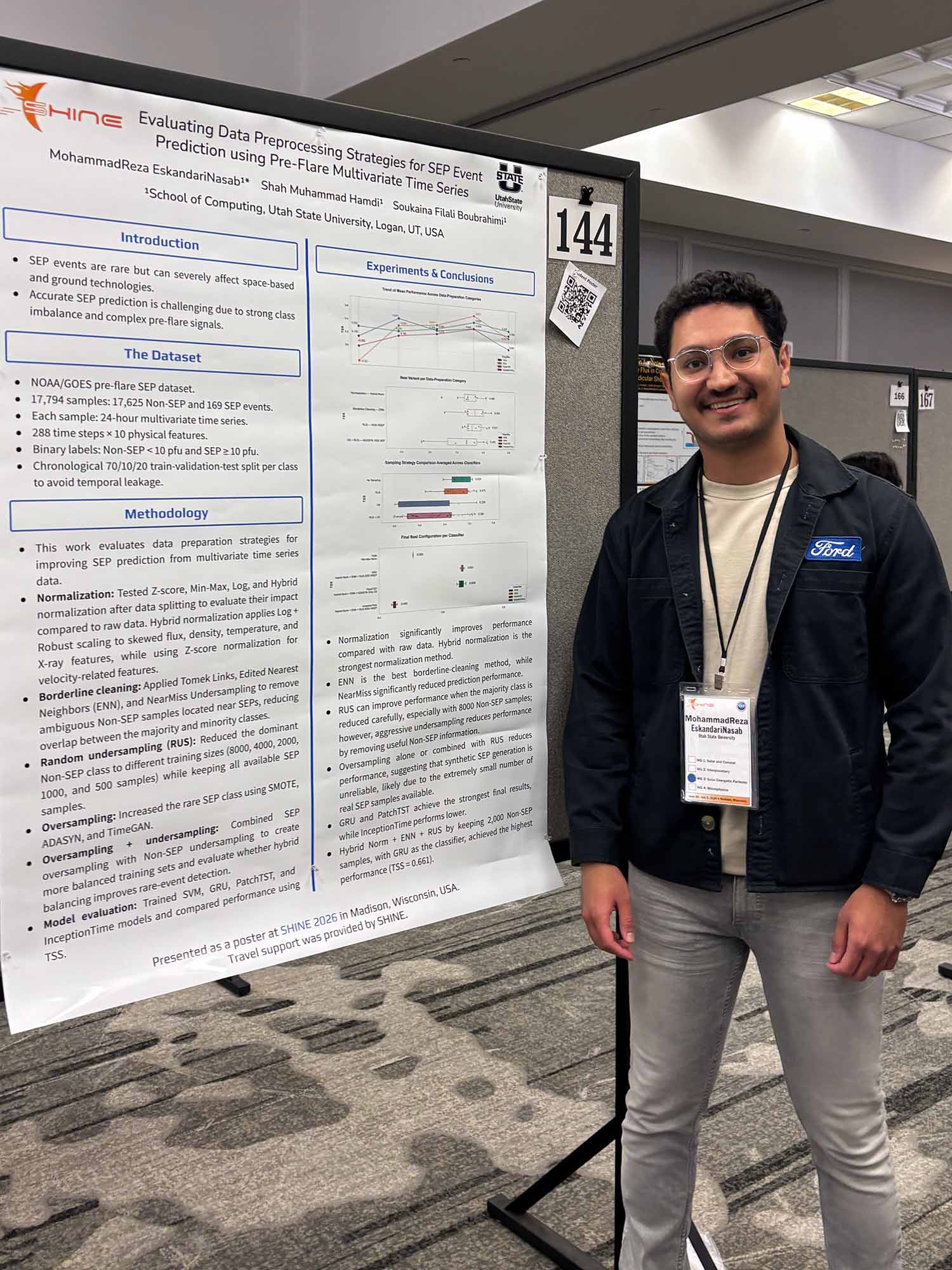
NSF Grant Award to Attend SHINE 2026 Workshop

Fully-funded travel award to present a poster on the data-preprocessing pipeline for solar energetic particle (SEP) event prediction, Madison, Wisconsin.

IEEE ICDM Conference Travel Award

Competitive $500 NSF-funded travel award granted to a limited number of students nationwide.

Contributor to NSF Award #2530946 (CAIG Project)

Proposed UNISON, a multimodal generative model with new loss functions and architectures for space-weather time series.

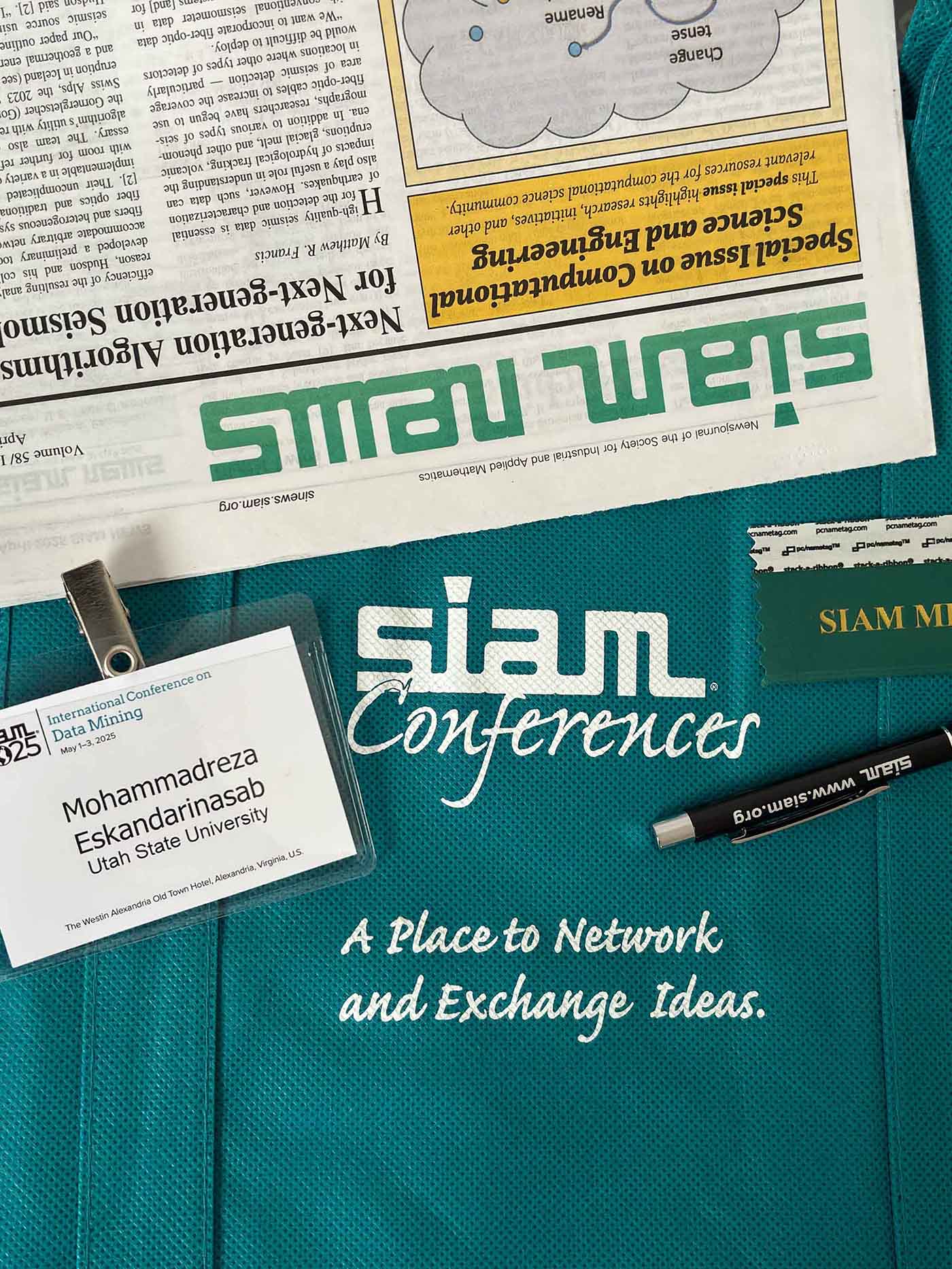
SIAM SDM 2025 Student Travel Award

$800 travel grant, free registration, and SIAM membership.

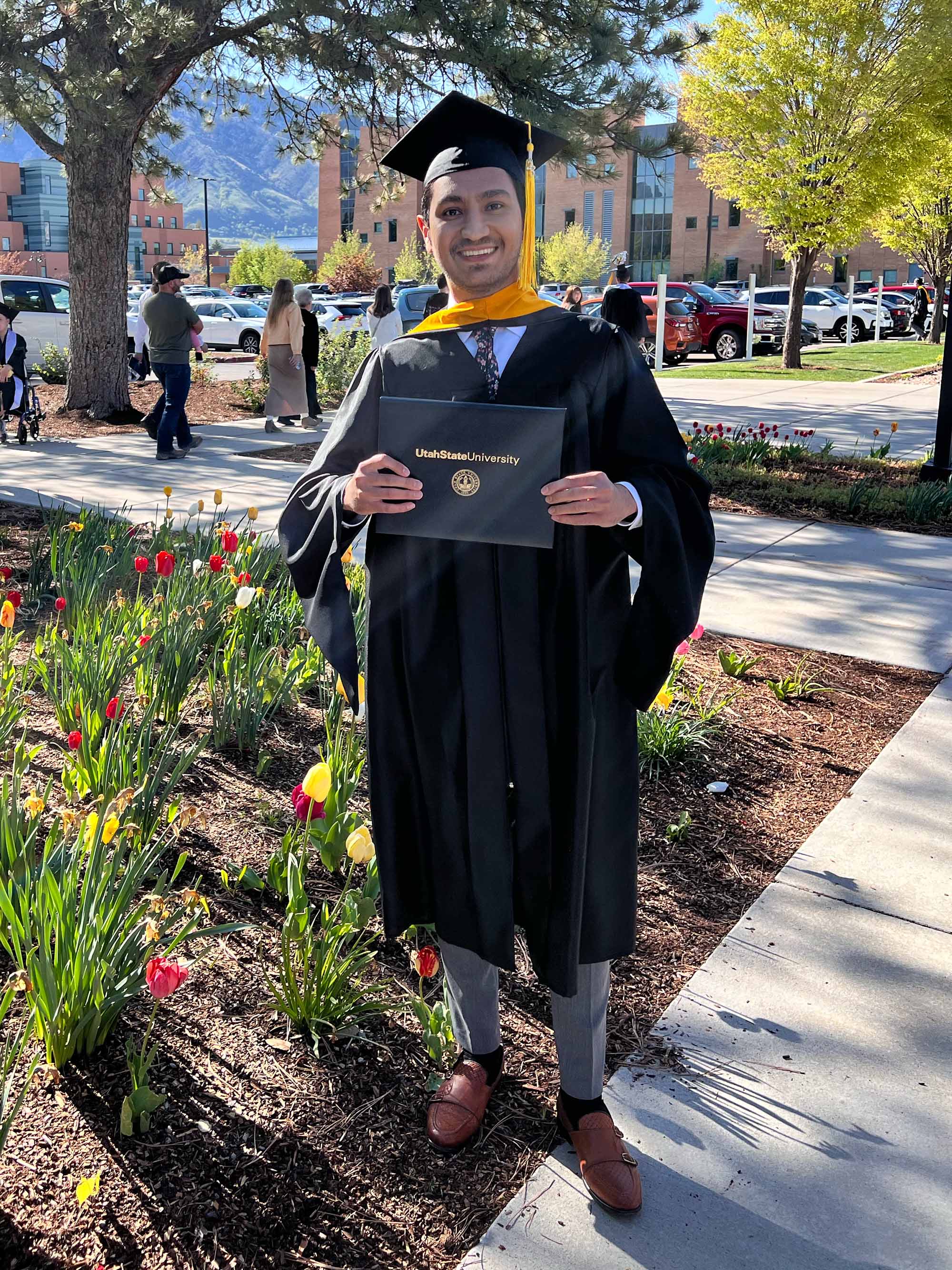
Awarded Thesis-Based MSc in Computer Science

Awarded midway through PhD studies for research contributions and academic excellence.

IEEE BigData Conference Travel Award

Competitive $800 NSF-funded travel grant awarded to 35 students nationwide.

Graduate Student Travel Award, Utah State University

Two $300 awards supporting travel to IEEE BigData 2024 and IEEE ICDM 2025.

NSF Grant Award, SHINE 2024 Workshop

Fully-funded 7-day participation in Alaska; delivered opening talk and poster on solar-flare classification.

NSF-Funded Research Assistantship Award

Supported AI model training for solar-flare prediction without coding knowledge (Award #2305781).

Direct PhD Admission, Utah State University

Admitted to the direct-entry PhD program via interview and high test scores.

SHINE 2026 Workshop, Madison, Wisconsin

Poster presentation on the data-preprocessing pipeline for SEP event prediction.

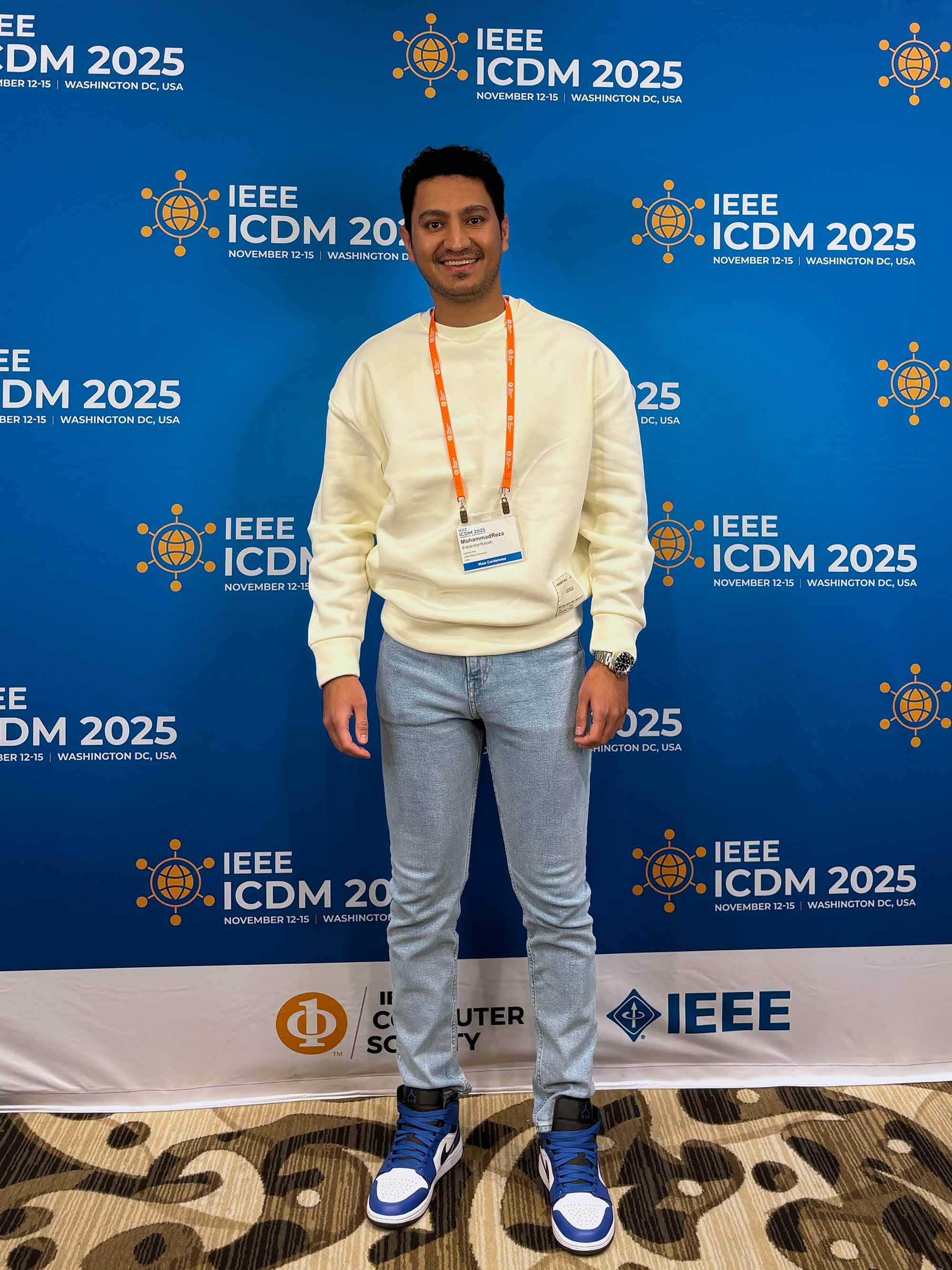
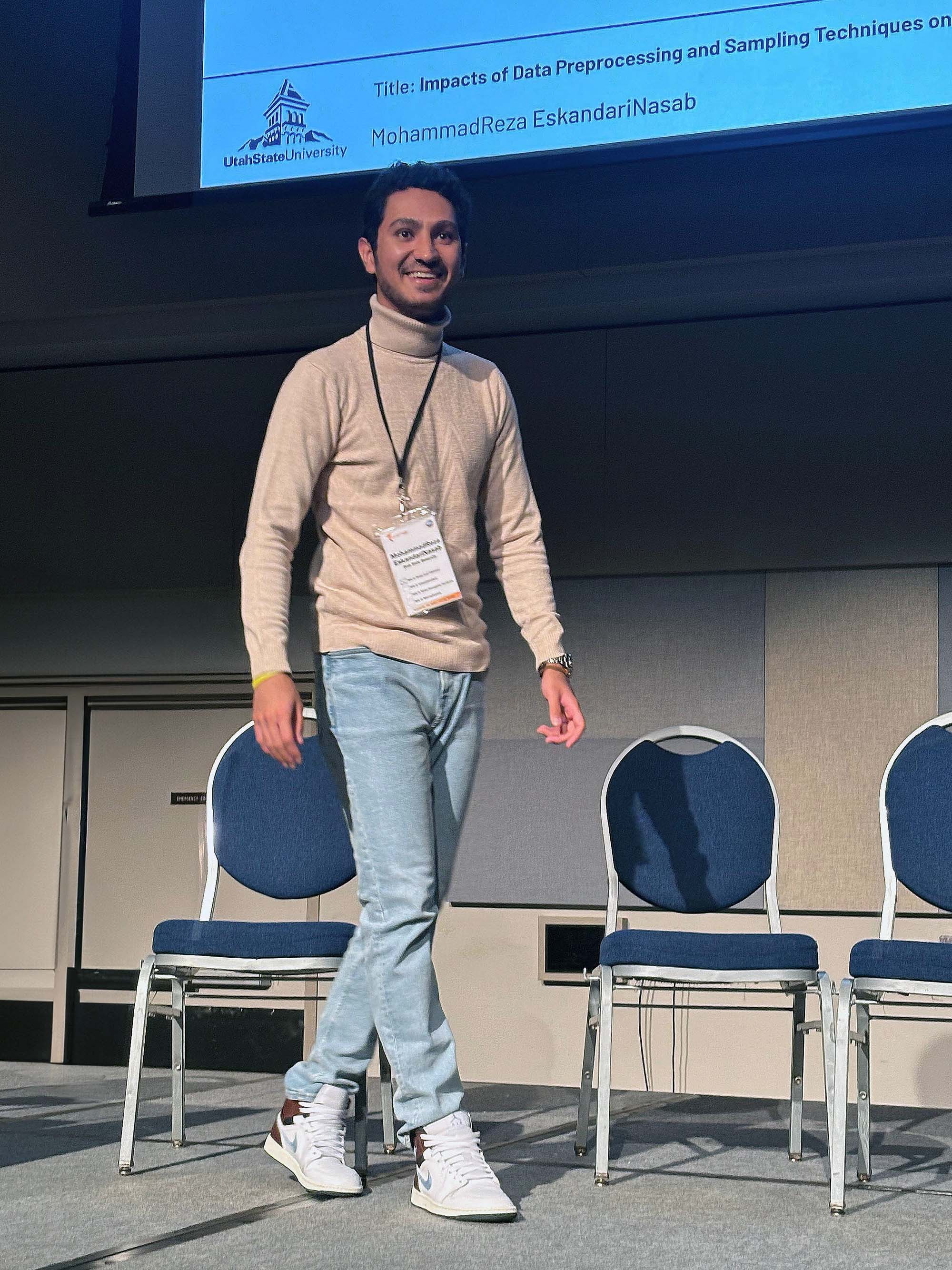
IEEE ICDM 2025, Washington, DC

Oral presentation of first-author paper TIMED.

SIAM SDM 2025, Alexandria, Virginia

Oral presentation of first-author paper AVATAR.

PhD Qualifying Examination, Utah State University

Presented two recent papers; responded to a five-member committee.

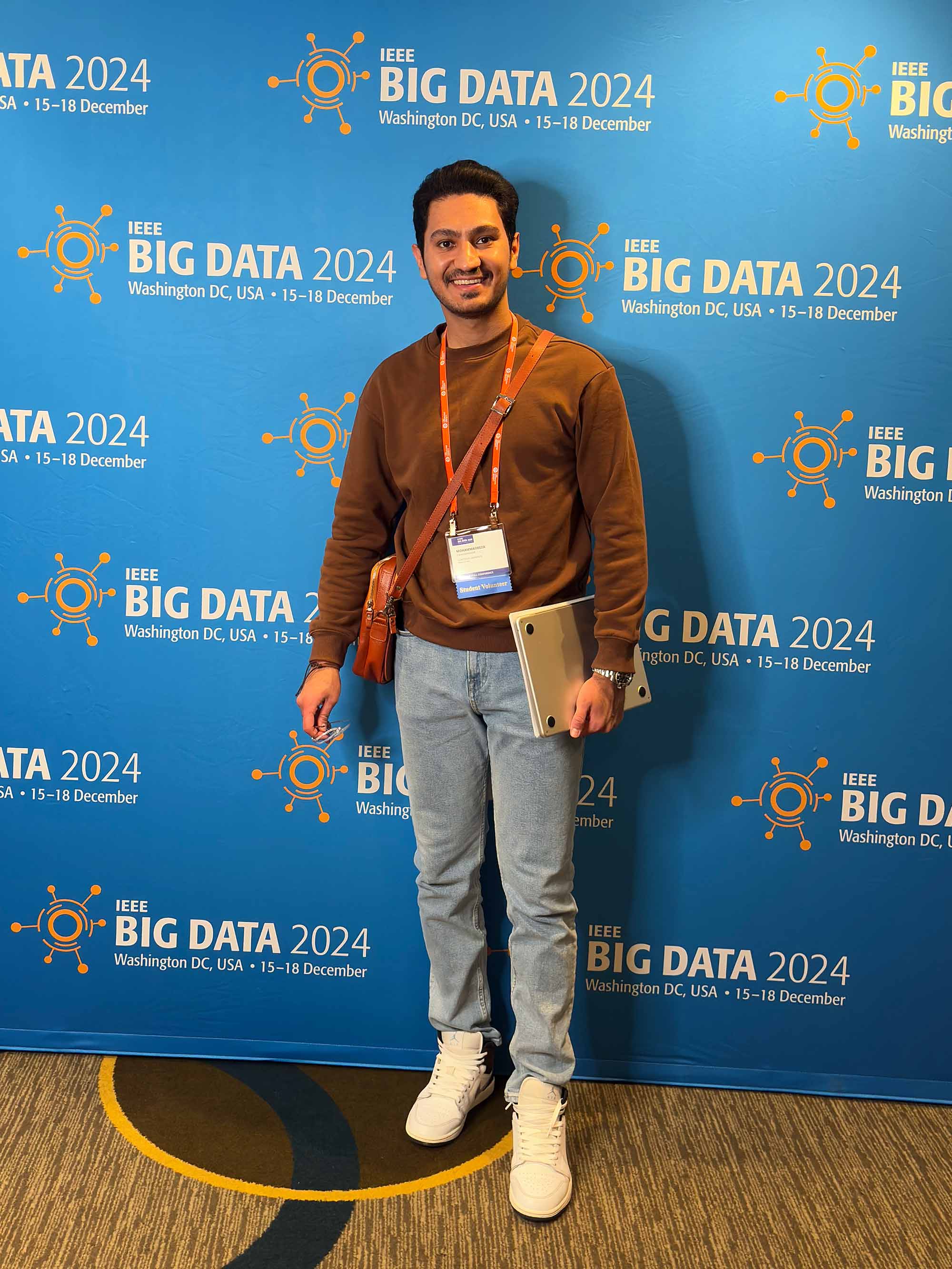
IEEE BigData 2024, Washington, DC

Oral presentation of first-author paper SeriesGAN.

IEEE ICMLA 2024, Miami, Florida

Virtual oral presentations of two first-author regular papers.

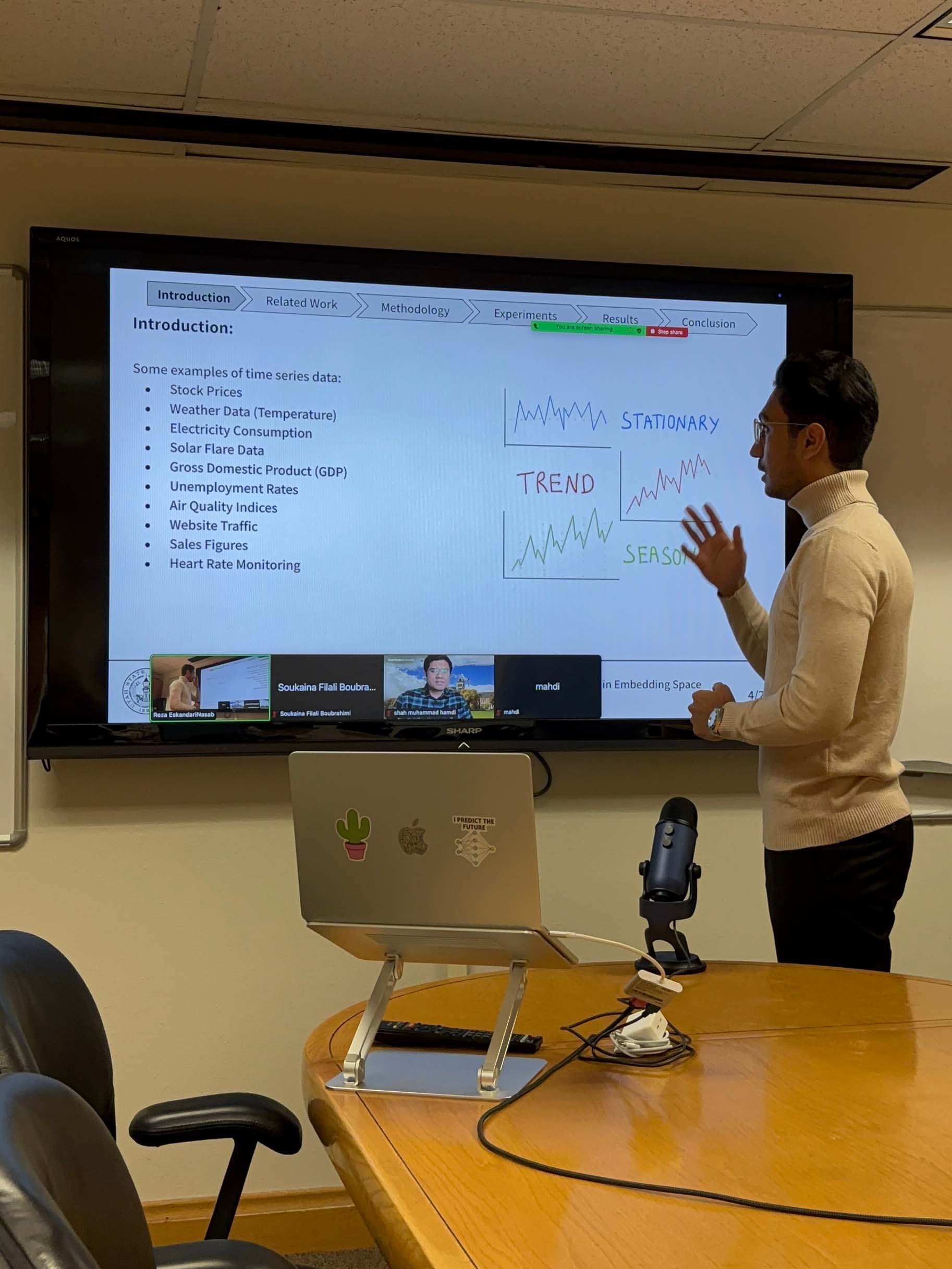
Master's Thesis Defense, Utah State University

Defended Supervised GANs for Time Series Generation in Embedding Space.

SHINE 2024 Workshop, Juneau, Alaska

Session talk and poster on preprocessing and solar-flare prediction.

Utah State University — STEM Outreach Presenter

Presented data science and solar-flare prediction to Indigenous high-school seniors, supported by NSF Award #2305781.

Biomedical Signal Processing and Control (Elsevier)

Peer reviewer; 15 manuscript reviews completed.

Journal of Neural Engineering (IOPscience)

Peer reviewer; three manuscript reviews.

Biomedical Physics & Engineering Express (IOPscience)

Peer reviewer; three manuscript reviews.

Astronomy and Computing (Elsevier)

Peer reviewer; two manuscripts.

Information Fusion (Elsevier)

Peer reviewer; two manuscripts.

SoftwareX (Elsevier)

Peer reviewer; two manuscripts.

IEEE ICDM (IEEE)

Co-reviewed two conference submissions.

Artificial Intelligence (Elsevier)

Peer reviewer; one manuscript.

The Astrophysical Journal (IOPscience)

Peer reviewer; one manuscript.

Pattern Recognition Letters (Elsevier)

Peer reviewer; one manuscript.

Neurocomputing (Elsevier)

Peer reviewer; one manuscript.

Information Sciences (Elsevier)

Peer reviewer; one manuscript.

IEEE J. Biomedical and Health Informatics

Peer reviewer; one manuscript.

Internet of Things and Cyber-Physical Systems (KeAi)

Peer reviewer; one manuscript.

Applied Energy (Elsevier)

Peer reviewer; one manuscript.

IEEE ICDM — Student Volunteer

Help-desk support, room directions, session navigation, attendee assistance, Washington, DC.

IEEE BigData — Student Volunteer

Technical and logistical support to session chairs; session coordination, Washington, DC.

Garrett Woodhouse

B.Sc. Computer Science, Utah State University. Mentoring on NSF Award #2530946 research into solar energetic particle (SEP) event prediction through weekly meetings covering preprocessing pipelines, ensemble models, and scientific writing; co-authored two manuscripts submitted to ApJS.

Kishore Ragul Alagarsamy

M.Sc. Computer Science, Utah State University. Mentoring on the deployment and migration of FlaPLeT.org from a Windows to a Linux production environment.

Latest

News

SoftwareX journal article on FlaPLeT published.

Received IEEE ICDM Conference Travel Award; volunteered at IEEE ICDM 2025.

Contributed to NSF Award #2530946 (CAIG Project) via the proposed UNISON model.

Received SIAM SDM 2025 Student Travel Award; presented AVATAR.

Completed PhD qualifying examination at Utah State University.

Completed MSc in Computer Science; presented at IEEE BigData & IEEE ICMLA.

Let's talk

Building the next lab, together.

I welcome conversations about tenure-track faculty opportunities, research collaboration, and student mentorship.